Wish You Were Here (1975)
Pink Floyd
"Oh by the way, which one's Pink? ..."
Part tribute to departed band co-founder Syd Barrett, part criticism of the recording industry, "Wish You Were Here" proved that the group could provide a worthy follow-up to 1973's "Dark Side of the Moon."
The overall theme of the album is absence. In fact, Roger Waters said that the title could have just as easily been "Wish We Were Here," when enthusiasm for the project waned in the beginning, as members of the group were filled with self-doubt about trying to follow up a wildly successful album — about being a rock band at all.
Design team Hipgnosis took the theme and visualized it as four photos for the album jacket and sleeve, also playing on the four basic elements: earth, fire, air and water. To further the concept, the LP was sold wrapped in an opaque plastic, in some way making the album itself absent, if only from the eyes of the buying public. The now-familiar logo of the mechanical shaking hands was stuck to the outside, a symbol of a gesture that should be filled with warmth and meaning, but more often is reduced to a cold, empty ritual. The logo also evokes a song on the album: "Welcome to the Machine."
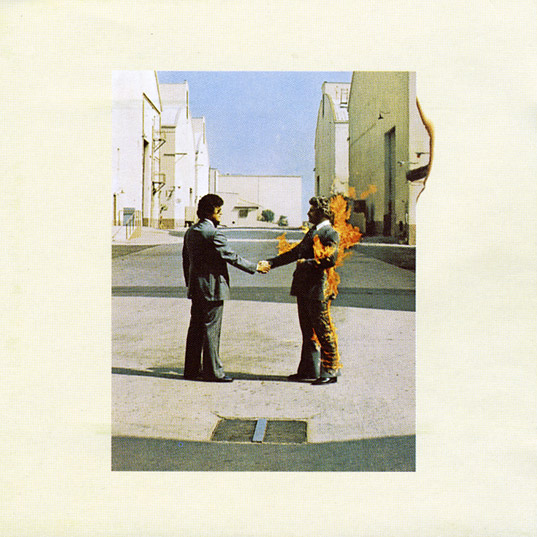
By covering the true album artwork with the plastic wrap, Hipgnosis was given free reign to be as creative as it wished in producing the cover art underneath. Since it wouldn't be seen on the store shelves, it could hardly be responsible for selling — or not selling — the album. The result was one of the more memorable Floyd covers: a man shaking hands with a burning Doppelgänger of himself, which was photographed in the Burbank Studios lot in Los Angeles, Calif. (To get a more accurate view of the photo, hold it up to a mirror. Because the direction of the wind caused the stuntman to get his face burned by the flames, the models were directed to switch positions and shake with their left hands. The photo was then reversed during processing, with some retouching, we have to assume, to right the now-reversed number 20 on the building.) The cover shot was rivaled only by the back cover: an invisible record salesman in a barren desert, pushing his product of a transparent LP.
Read more: "The story behind Pink Floyd's Wish You Were Here cover photo"
One photo rejected by the band was that of an automobile pulled over to the side of the road at dusk — or is it dawn? The wind is kicking up a newspaper, the headline of which reads, "Pop Star Dies in Car Crash." Hipgnosis's Storm Thorgerson wrote, "It was about the arrival of a premonition, which, if true, would mean that its subject could not be there to receive it. Floyd thought it naive." The team would use the shot instead for Kitsch's "Heavy Metal Kids" album the following year, and a photo of a veil suspended by the wind would take its place inside "Wish You Were Here." (Yes, there is a woman veiled behind the veil — though seeing her is akin to being able to see the images hidden in those computer-generated images so the rage in the early '90s.)
Floyd began recording the "Wish You Were Here" album Jan. 6, 1975, and wrapped up in July of the same year. Throughout the course of the work, they received two visitors of consequence — one invited, the other not.
When Waters was having trouble with the vocal to "Have a Cigar," a sharp poke at the recording industry, he decided to pull in friend Roy Harper to sing the song. Harper was in one of the other Abbey Road studios recording his H.Q. album, to which David Gilmour had contributed some guitar work.
Having someone outside the band sing the song added an extra dose of realism when Harper crooned, "Oh, by the way, which one's Pink?", a question the band was actually posed on at least one occasion by schmoozing music biz types. (In fact, no one is "Pink." Pink Floyd, the group, took its name from two American bluesman: Pink Anderson and Floyd Council. And while everyone who thought Pink Floyd was the name of a person was left out of the joke, the rest of us could chuckle in appreciation of Waters's vicious wit.)
On June 5, another visitor wandered into the control room as the band was wrapping up the final mix of "Shine on You Crazy Diamond." A heavy-set man with shaven head and eyebrows, he went unrecognized for some time, until the band realized it was Barrett, apparently unaware that the "crazy diamond" in the song was a direct reference to himself. No one in the group had seen Barrett in seven years, and no one saw him again.
"Wish You Were Here" hit the United States charts running on Sept. 27, 1975, at number 12. It climbed to number one on Oct. 4, making it the group's second number one in the U.S., after 1973's "Dark Side of the Moon." In the U.K. it debuted at the number one position, thanks to advance sales of a quarter million. If there was a lesson in the success of "Dark Side of the Moon," the band's record label didn't learn it. It was caught unable to fulfill the strong demand for the new album from the Floyd. Record plants worked extra shifts, but, initially, the company could fill only half its orders.
The version of the album we play on "Floydian Slip" is the Columbia MasterSound Edition. This gold disc series uses Sony's Super Bit Mapping for a supposedly superior sound.
The overall theme of the album is absence. In fact, Roger Waters said that the title could have just as easily been "Wish We Were Here," when enthusiasm for the project waned in the beginning, as members of the group were filled with self-doubt about trying to follow up a wildly successful album — about being a rock band at all.
Design team Hipgnosis took the theme and visualized it as four photos for the album jacket and sleeve, also playing on the four basic elements: earth, fire, air and water. To further the concept, the LP was sold wrapped in an opaque plastic, in some way making the album itself absent, if only from the eyes of the buying public. The now-familiar logo of the mechanical shaking hands was stuck to the outside, a symbol of a gesture that should be filled with warmth and meaning, but more often is reduced to a cold, empty ritual. The logo also evokes a song on the album: "Welcome to the Machine."
By covering the true album artwork with the plastic wrap, Hipgnosis was given free reign to be as creative as it wished in producing the cover art underneath. Since it wouldn't be seen on the store shelves, it could hardly be responsible for selling — or not selling — the album. The result was one of the more memorable Floyd covers: a man shaking hands with a burning Doppelgänger of himself, which was photographed in the Burbank Studios lot in Los Angeles, Calif. (To get a more accurate view of the photo, hold it up to a mirror. Because the direction of the wind caused the stuntman to get his face burned by the flames, the models were directed to switch positions and shake with their left hands. The photo was then reversed during processing, with some retouching, we have to assume, to right the now-reversed number 20 on the building.) The cover shot was rivaled only by the back cover: an invisible record salesman in a barren desert, pushing his product of a transparent LP.
Read more: "The story behind Pink Floyd's Wish You Were Here cover photo"
One photo rejected by the band was that of an automobile pulled over to the side of the road at dusk — or is it dawn? The wind is kicking up a newspaper, the headline of which reads, "Pop Star Dies in Car Crash." Hipgnosis's Storm Thorgerson wrote, "It was about the arrival of a premonition, which, if true, would mean that its subject could not be there to receive it. Floyd thought it naive." The team would use the shot instead for Kitsch's "Heavy Metal Kids" album the following year, and a photo of a veil suspended by the wind would take its place inside "Wish You Were Here." (Yes, there is a woman veiled behind the veil — though seeing her is akin to being able to see the images hidden in those computer-generated images so the rage in the early '90s.)
Guests, expected and otherwise
Floyd began recording the "Wish You Were Here" album Jan. 6, 1975, and wrapped up in July of the same year. Throughout the course of the work, they received two visitors of consequence — one invited, the other not.
When Waters was having trouble with the vocal to "Have a Cigar," a sharp poke at the recording industry, he decided to pull in friend Roy Harper to sing the song. Harper was in one of the other Abbey Road studios recording his H.Q. album, to which David Gilmour had contributed some guitar work.
Having someone outside the band sing the song added an extra dose of realism when Harper crooned, "Oh, by the way, which one's Pink?", a question the band was actually posed on at least one occasion by schmoozing music biz types. (In fact, no one is "Pink." Pink Floyd, the group, took its name from two American bluesman: Pink Anderson and Floyd Council. And while everyone who thought Pink Floyd was the name of a person was left out of the joke, the rest of us could chuckle in appreciation of Waters's vicious wit.)
On June 5, another visitor wandered into the control room as the band was wrapping up the final mix of "Shine on You Crazy Diamond." A heavy-set man with shaven head and eyebrows, he went unrecognized for some time, until the band realized it was Barrett, apparently unaware that the "crazy diamond" in the song was a direct reference to himself. No one in the group had seen Barrett in seven years, and no one saw him again.
Chart success
"Wish You Were Here" hit the United States charts running on Sept. 27, 1975, at number 12. It climbed to number one on Oct. 4, making it the group's second number one in the U.S., after 1973's "Dark Side of the Moon." In the U.K. it debuted at the number one position, thanks to advance sales of a quarter million. If there was a lesson in the success of "Dark Side of the Moon," the band's record label didn't learn it. It was caught unable to fulfill the strong demand for the new album from the Floyd. Record plants worked extra shifts, but, initially, the company could fill only half its orders.
The version of the album we play on "Floydian Slip" is the Columbia MasterSound Edition. This gold disc series uses Sony's Super Bit Mapping for a supposedly superior sound.
Release date
Sep 15, 1975 (UK)
Sep 12, 1975 (US)
Rating ( votes)


Thanks for rating "Wish You Were Here"
Track listing
- Shine on You Crazy Diamond (Parts I-V)
13:37 (Waters/Wright/Gilmour) - Welcome to the Machine
07:25 (Waters) - Have a Cigar
05:25 (Waters) - Wish You Were Here
05:19 (Waters/Gilmour) - Shine on You Crazy Diamond (Parts VI-IX)
12:26 (Waters/Wright/Gilmour)



