Making
Radio Waves
He
may be only coming through in waves, but each week, Craig Bailey's
hour-long Floydian Slip is reaching out to Pink Floyd fans old and
new
By Rick
Karhu
sk
any Floyd fanatic in Burlington, Vermont what they're doing on Sunday
night between 7 and 8 PM and you'll likely hear about Craig
Bailey's Floydian Slip, an hour-long, weekly radio program devoted
to the long and meandering musical careers of the members of Pink
Floyd. Broadcast on Champ 101.3, Floydian Slip has been going
strong for over four years now and shows no sign of slowing down.
A managing
editor and webmaster of a local business magazine, Bailey is also
a contributing writer to a variety of publications and, curiously
enough, a published playwright. Doubtless, Floydian Slip is his
real passion though and each week, Floyd fans in and around Burlington
are treated to Bailey's trip through Floydian space. He produces
and hosts each weekly show as a hobby, but make no mistake
Floydian Slip has the sound and pacing of the most professional
of radio programs and serves to promote the love of Floyd music
quite well. (This is no surprise since Bailey's professional broadcast
experience extends beyond his years working on Floydian Slip.)
You may already
be peripherally aware of Craig from his regular Internet posts on
various Floyd forums, his weekly updates of each show's playlist.
The casual reader of any such forum may wonder what the relevance
of a remote Floyd radio show has to them without realizing that
the answer is in front of them. With the seemingly daily improvements
in the speed and reliability of the Internet as a true multimedia
experience, those of us who live nowhere near Vermont may someday,
hopefully, get to share in the experience of tuning in to Floydian
Slip albeit via modem.
I recently
had the opportunity to run a few questions by Craig who was more
than happy to oblige, giving his feedback about the future of Floydian
Slip, the Internet and Pink Floyd.
Spare
Bricks: When did you become a fan of Pink Floyd?
Do you remember the first time you heard them?
Craig
Bailey: I can't recall the first time I heard them, but do remember
the first time I heard the group's name. It was shortly after "The
Wall" came out; I must have been in 7th grade. My cousin
from Connecticut, who was three years older than me, was complaining
during his visit to Vermont that none of us people up here in the
sticks knew what was cool. He told me he couldn't wait to get back
home and listen to Pink Floyd's "The
Wall," and then told me I probably didn't know what the hell
he was talking about. I didn't. And like most people who hear the
band's name for the first time, I assumed Pink was a solo act, not
a band.
My next recollection
was as Roger Waters' "The
Pros and Cons of Hitch Hiking" was coming out. I remember
listening to CHOM-FM out of Montreal on my Sony Walkman, and the
jock was talking about Roger's "first release since leaving Pink
Floyd." Again the confusion: What a strange way to phrase it,
I thought, still believing Pink was a man. (I realize much of my
credibility has vanished now that I've admitted this!)
Well, somewhere
along I caught on. By college I was much more "in the know," and
played Floyd along with loads of other classic rock acts on 106-VIC,
the rock station at Ithaca College in Ithaca, N.Y., where I went
to school from 1985-1989.
I credit my
friend, Greg Perez, with really turning me onto the band though.
During a visit home from college I'd guess its was late 1986
or early 1987 he slipped me a cassette copy of Dark Side
that he made from his LP, and that clinched the deal. If ever there
was an argument for illegal taping, that single copy of Dark
Side was it: Since then I've bought every Floyd and solo album probably
twice over, and have, most likely, turned many more people onto
the band through "Floydian Slip."
Anyway, I'm
sure by many people's standards I'm a "late bloomer" when it comes
to being a Floyd fan. I like to think what I lost in a late start
I more than made up for in determination and hard work! Maybe it
was fate: I was born Aug. 3, 1967 a day or two before the
band released its first album.
SB:
How did "Floydian Slip" come into being?
CB: At Ithaca College, my senior year. This was after Greg had turned
me onto the band. Another student had a Floyd show on 106-VIC
I think he was calling it "The Pink Floyd Hour" but
didn't wish to continue it another semester. I took it over the
final semester of my senior year, 1989, and renamed it "Floydian
Slip."
After graduation
I worked for WDEV, an eclectic AM station in Waterbury, Vt.
but not so eclectic that a Floyd show would have fit into the scheme
of things. When I left in 1994 to work for WEXP in Burlington, I
started doing the show once a month during the new moon. (When the
moon's dark; get it?) I think the show there was a compromise: I
think management let me do the show more as a favor to me; less
because they thought it might have fit their mission.
WEXP essentially
went out of business within a year; I was out of a job and eventually
shifted careers if you can call it that into publishing.
But shortly
after WEXP pulled the plug, I made a formal, written proposal for
"Floydian Slip" to the two rock stations in Burlington, Vt. Rich
Haskell had just jumped ships from the station's rival to Champ
101.3 to be Champ's program director. A huge progressive rock fan,
he knew "Floydian Slip" from WEXP and said he'd love to air it on
Champ. But they had to find a sponsor first. After about four months
they did, and I started producing the show for Champ, Oct. 25, 1995.
I really credit Rich with championing the show in the beginning.
I sometimes wonder if without his enthusiasm whether the show would
have found a home. As of this interview, I'm up to something like
224 shows with Champ.
SB:
Where do you see your show going eventually? Do you have any plans
for expanding your audience?
CB: A couple of years back I looked into syndication, but couldn't
quite crack the nut. Most syndicated shows are given to stations
free of charge, with the agreement that the station will air the
program in its entirety, including the syndicator's ads. Syndicators
sell advertisers on the fact that their ads will be carried on X
number of radio stations. That way they can charge advertisers a
substantial amount, and thus afford to duplicate and distribute
the show free of charge while still making a profit.
So getting
started would seem to be the hard part: How can you charge advertisers
a substantial amount when you're not on many stations? How can you
afford to give the show away to a significant number of stations
until you have the advertising revenue? Chicken and the egg.
I guess the
answer is, find an investor to back you through the lean years until
the operation is truly up and running. So far, I haven't committed
myself to doing that.
More likely,
I'd say, Champ will probably eventually begin netcasting its signal,
like a lot of other stations have. (This isn't inside information;
I'm just speculating.) When that happens, "Floydian Slip" will be
available anywhere in the world. Netcasting the show on my own doesn't
seem to be practical: BMI/ASCAP fees alone would make it extremely
expensive. Not to mention the difficulty in taking a copy of the
show and getting it on a server somewhere. (The "Floydian Slip"
Web site is hosted by an ISP; like many webmasters, I don't own
and manage my own server.)
SB:
How much feedback do you get from your listeners?
CB: What you have to remember is that the mass media really are
one-way channels. Producing a radio show or at least one
on the scale of "Floydian Slip" is a pretty solitary operation.
I go to the studio once a week to spend about an hour and a half
prerecording my hour-long show, and then go home. I do it in the
evening.
Considering
the four stations that are run out of the Champ facility are semi-automated
they can be "loaded up" by a jock and left to run on their
own for long stretches and that I record during the evening,
I don't even see anyone else from the station much less have any
contact with listeners. A little spooky especially when I'm
playing something like "Careful with That Axe, Eugene." Considering
my schedule requires I prerecord the show, I'm not in the studio
answering the phone should anyone call while it airs.
Feedback from
listeners is usually via email. Though of the tons of email I receive
about the show, a very small percentage, I suspect, is from people
who can listen to the show. Most of it comes from folks across the
globe who come across my Web site, or have seen one of my weekly
songlist postings on Usenet.
The show really
does have an international reputation. There
have been a couple of instances where I've learned of the show's
reputation far outside Champ's listenership: Once a former coworker
of mine, now working for Turner Broadcasting in Atlanta, Ga., mentioned
my name to a coworker out there, and the guy knew who I was. Another
time my girlfriend's mother in Maine mentioned the show to a friend's
16-year-old son, who knew all about it. Strange.
There have
been a couple of people, if you can believe it, who have emailed
me to tell me that they live in other parts of the country, and
can't listen to the show. So what they do is pull my weekly songlist
from the Web site, and recreate the show, using their own CDs and
LPs. Stranger.
Occasionally
I've made public appearances mostly attending shows by The
Machine, a Pink Floyd cover band Champ and
"Floydian Slip" often sponsor when the band's in town. (Their final
Burlington-area appearance would seem to be March 9, 2000, at Higher
Ground in Winooski, since they're packing it in after about 11 years
of touring.) In cases like that I'll almost always have a few people
approach me and tell me they like the show. That's always satisfying.
Once I introduced
The Machine at a show in Burlington. I suspected a cool reception,
since I figured the crowd would probably be psyched to hear the
band and wouldn't be too into some radio guy wasting their time
shooting his mouth off beforehand. The crowd went nuts when I mentioned
the show maybe it was all the beer. ;) And before I even
got the words out of my mouth, someone in the crowded shouted out,
"Floydian Slip!" Sometimes it's easy to forget that what you do
in the studio each week is actually being broadcast to who-knows-how-many
people.
SB:
Have you made any new fans of Pink Floyd
with your show?
CB: I'm sure I have, though I don't have any proof. When I do engage
in an email exchange with a listener, if often takes the form of,
"I've got this album and that album; what would you recommend next?"
That sort of thing. That's always fun: helping someone discover
Floyd. I wish I could do it all over again myself.
SB:
I notice the song selection for your show not only has a theme,
but that it's arranged in such a way that the play list contrasts
well; you have a fast, loud song, followed by a softer one
an old song next to a newer one. Is that a conscious thing or does
it just work out that way?
CB: I put a lot of time into choosing the songs. I work it all out
on my word processor before I go into the studio. The goal is variety
while still maintaining good segues. At the same time, I make a
strong effort to not play the same songs week after week. Many times
several months will pass before you hear the same song on "Floydian
Slip."
When you see
a loud song followed by a soft one on my playlist, most likely there
was a talk set in the middle. With three 18-minute-or-so segments
in each show with commercials filling in between the
show often takes the form of three movements. There might be a Syd
Barrett/early Floyd movement; a quiet, acoustical movement;
a synth movement; a post-Waters movement; a "glory years" movement
things like that. I try not to switch gears too harshly without
something in between, like some talk or a spot break, acting as
a clutch, if you will.
With all the
interesting segues Floyd puts in between its songs, stringing songs
along during "Floydian Slip" so that listeners can barely tell where
one begins and another ends is a lot of the fun of it. I try to
keep the talk to a minimum. My feeling is people aren't tuning in
to hear me yap.
SB:
On the show you sent me, you mention a 'friend over the Internet'.
What sort of impact has the Internet had on the content of your
show?
CB: I've had a few people I've "met" on the Net send me Floyd rarities
that I've played on the air. When Waters's "Lost
Boys Calling" was available as an MP3, before you could find
it in U.S. stores, I downloaded it and played it on the show. In
that case, the Net allowed me to get the song on the air long before
I would have been able to otherwise. (Incidentally, someone from
the Net sent me a CD of the song shortly after that, which I played
until I could get a copy from Sony some time later.)
I also take
requests through my Web site. For the past three years, I've averaged
1,080 requests a year. The problem is, I often can't tell if they're
coming from local listeners of the show or not. Many obviously come
from foreign addresses from people who don't realize it's
a local show, or simply think it'd be cool to request a song nonetheless.
I only honor requests from people who follow their request up with
confirmation that they're local.
But as far
as musical content, the Net doesn't contribute a whole lot to "Floydian
Slip."
Information-wise,
I often find the Net helpful, though approach a lot of what I learn
with a healthy dose of caution. Through Echoes and Usenet, it's
easy to get a heads-up about certain things, though I'll rarely
take the word of a random poster to the Net. Instead, I'll often
use, for example, a post from someone on Echoes about how EMI UK
has reported something about Floyd as a tip to dig up the EMI UK
Web site and get the information straight from the horse's mouth.
Someone on Usenet says that there's a cover story in Guitar World
magazine about "The Wall"; I hit the bookstore and find a copy.
For a long
time, there wasn't a whole lot of information to report on, with
the band being so inactive. With the new album coming out ("Is
There Anybody Out There? The Wall Live") and Waters's 1999/2000
tour, there's been a lot, comparatively, to keep track of. The Net's
helped a lot.
I've also
made good contacts with record label people and the like through
the Net. When Rick Wright's "Broken
China" came out a couple years back, the label contacted
me via email, which resulted in promo copies of the CD. My contacts
with Floyd cover bands like The Mood and The Machine, and The Squirrels,
a West coast band that recorded a parody album of Dark Side, have
all been made through the Net. My interview with Storm
Thorgerson also started when a publicist contacted me via the
Net.
SB:
What was that like, interviewing Storm?
CB: I don't consider myself a strong interviewer much too
self conscience. But when I got the chance to talk to Storm following
the release of his book, Mind Over Matter: The Images of Pink Floyd,
I didn't see how I could turn it down. Realistically, it's probably
the closest to the band I'll ever get.
I was very
nervous, though Storm turned out to be this clownish kind of guy
very whimsical and apparently willing to talk about anything
I wanted to talk about for as long as I wanted. Definitely a positive
experience. Very exciting.
Because of
the time difference, I called him in his London office at something
like 7:30 in the morning from my home, and we talked for a half
hour. Then I edited the thing for broadcast, and put a transcript
of the entire interview online at http://www.floydianslip.com/storm.htm.
I think the
transcript might be one of the few Storm resources on the Web: I
get a lot of people emailing me feedback about it. (Number one question:
"Can you put me in touch with Storm?")
SB:
What advice would you give to someone wanting to start up their
own Floyd radio show?
CB: First off, if you don't have on-air experience, get some. Regardless
of your concept for a show, no commercial radio station will be
interested unless you're air-worthy.
College stations
are great places to get your start. If you're a student, good enough.
But many college stations open their studios to members of the community.
That's a great way to get your feet wet and develop some on-air
skills. Furthermore, if you're happy with the station, you can probably
develop your Floyd show idea right there: College and noncommercial
stations are much more open to less-mainstream ideas than commercial
outlets.
If you're
interested in getting the show on a commercial station, you might
be in for more of an uphill climb. If you're already a full-timer
staffer like I was at WEXP when I produced "Floydian Slip"
there it'll most likely just be a matter of convincing the
powers that be to let you air your show. (Especially if you're a
salaried worker: No skin off their back, right? And if they can
make revenue by selling advertising on the show, all the better
for them.)
If you're
an outsider, like I was when I proposed the show to Champ, realize
that few commercial stations would be willing to pay you to produce
a specialty show, unless it's bringing them in some green. For example,
Champ was interested in my show at first glance, but we had to wait
a few months until their sales department found a sponsor.
Commercial
radio is primarily a business. You gotta remember that.
I consider
myself lucky to be able to produce such an eclectic show on a station
that otherwise plays a relatively tried-and-true collection of classic
rock songs. Furthermore, station management was been kind enough
to allow me to have 100 percent creative control over "Floydian
Slip." Not many jocks have the luxury of choosing the music they
play. After working in radio full-time for several years, it's really
"just desserts" for me.
SB:
And finally, if you could change one thing about Pink
Floyd as they are now, what would it be?
CB: It'd be easy to say I wish Waters was still in the band. (And
I do.) But if I only had one wish, I guess it'd be to have the band
Gilmour, Wright and Mason active: recording albums
and touring. Simple as that. If I could look forward to an album
of new material every other year, and the chance to see them in
concert occasionally, that'd be my wish.
And if they'd
be willing to come on "Floydian Slip" to occasionally shoot the
(steel) breeze, that be pretty nice, too.
Rick Karhu
is Editor of Spare Bricks
This
article originally appeared in issue no. 4 of Spare
Bricks in Spring 2000. Copyright Spare Bricks Webzine.
After
the Floyd
Craig
Bailey's the man on the other side of the moon
by
Erik Esckilsen
f
you think you might know more about Pink Floyd
than Craig Bailey does, why don't you
send him e-mail? He'd enjoy hearing from you. Better yet, if you
know anything about the British rock group that has spanned three
decades the one responsible for such prog-rock chestnuts
as "Money" and "Another Brick in the Wall"
first listen to his radio show, "Floydian Slip," and then
e-mail him.
This Wednesday (Oct. 22, 1997) marks two years that the native Vermonter
has been producing and hosting the hourlong radio show every
Wednesday at 10 p.m. (Addendum: Sundays 7-8 p.m. as of March 22,
1998 ccb) on WCPV-FM (a.k.a. Champ 101.3) dedicated
exclusively to the work of Pink Floyd and its offshoots. Bailey
personally favors the band's middle, "concept album" period
guided by former bassist Roger Waters
in which focused on loose themes such as the drudgery of
daily life (Dark
Side of the Moon). But listeners of Floydian Slip are likely
to hear twisted, '60s-era psychedelic tunes as well as the ethereal
"corporate rock" that defines the group's more recent
work.
Contrary to the band's druggie image, Bailey says Pink
Floyd "really is kind of a thinking person's group."
Accordingly, he allows his audiences to make their own sense of
the allusions, heady poetry and cryptic spoken-word interludes that
characterize the music.
"I don't have any delusions that Floydian Slip, if it is successful,
has much to do with me," Bailey demurs.
The show surely appeals to fellow Floydians out there, but in fact
this deejay isn't quite sure who's listening. That's because
his show is pre-taped, an unfortunate necessity in the 30-year-old's
hectic schedule, which includes working as managing editor and Web
master at Greater
Burlington Business Digest and acting in local theater
productions (see review this issue of Theatre
Factory's Deathtrap).
And since the station doesn't subscribe to the Arbitron ratings,
there's no way to tell what kind of market share "Floydian
Slip" might be attracting. But that doesn't bother Champ program
director Rich Haskell, whom Bailey credits with championing his
proposal for the show. "He was smart," Haskell says. "He
came to someone he knew was a Floyd freak."
The fact that Pink Floyd continues to sell
out venues such as Montreal's Olympic Stadium is proof enough for
Haskell that the band is relevant in today's music market
even if some other management types reportedly consider the show
"an hour of off-the-wall weirdness."
Off-the-wall or another brick in it, Bailey's earned a sterling
reputation around the station for his work ethic.
"I've never met a guy who's so into something," Haskell
says. "We can just say, 'All right, Craig, do what you want,
go wild, have fun with it.' I don't even begin to make rules with
him. He is so thorough it's unbelievable."
That's hardly the description one might expect to hear of a Pink
Floyd fan, given the stereotypical image Bailey describes as
a "long-haired guy with a doobie hanging out of his mouth"
or the all-too-familiar fans who think Floyd's "that
band that says school sucks" (the basic theme of The
Wall). Indeed, Bailey's articulate, thoughtful manner,
well-trimmed beard and short locks convey a mildly corporate bearing.
You'd figure him for a Steely Dan fan, if anything.
But Bailey's Pink Floyd fandom is unquestionable
though it dates back only to 1987. And he's quick to note
that the band shares space on his CD shelf with the likes of Johnny
Mathis, Frank Sinatra and, yes, Steely Dan. Bailey is nonetheless
conversant on matters Floydian with an ease that betrays his fixation.
He knows, for example, that the group whom he refers to alternately
as "Floyd" and "the Floyd" is named for
Georgia bluesmen Pink Anderson and Floyd Council. (Anderson
was actually from South Carolina. — cb)
Bailey also
knows that the refracted light emanating from the prism on the Dark
Side of the Moon album cover is missing one color
he's pretty sure it's indigo.
The name of Bailey's production company, Random Precision Productions,
is a reference to a lyric from "Shine on You Crazy Diamond."
That cut from Wish
You Were Here is itself a reference to now-reclusive founding
member Syd Barrett, whose departure from the band in the late '60s
owing to a mental breakdown augmented by LSD is a
cornerstone of rock's drug-related history. The Random Precision
logo two crossed hammers inside a circle is a reference
to the band's 1979 recording and film, The
Wall.
During a recent broadcast, Bailey noted that "4:47 A.M. (The
Remains of Our Love)," from Roger Waters'
1984 The
Pros and Cons of Hitch Hiking, includes the only Pink
Floyd reference to Vermont a bit of arcana that places
him in a truly elite tier of Floyd fandom.
But if Bailey ever gets lonely at the top of Pink
Floyd's Green Mountain pyramid, it's not for lack of trying.
His labors in the cause of Floyd extend well beyond Champ's studios.
The Floydian Slip Web site (www.floydianslip.com), for which Bailey
composed some 14,000 words of discography, review and song-list
copy, receives a reported 4000 to 7000 hits a week. In a recent
issue of Vermont NOW: News on the Web, Karen Carroll commended
that the site's "professional presentation" as well as
the "thoroughness and tenacity" of Bailey's allegiance
to the Floyd.
Bailey's 250-some e-mail correspondents (pink@floydianslip.com)
keeps him in the loop on such pressing matters as Pink Floyd reunion
rumors, Syd Barrett sightings and the recent theory that Dark
Side of the Moon was composed and recorded to accompany
The Wizard of Oz (start your CD at the third MGM lion roar,
and decide for yourself).
While Bailey can't receive on-air calls during "Floydian Slip"
and has never had a live guest on the show, he did recently finagle
the next best thing: On September 30, he recorded a telephone interview
with London-based designer Storm Thorgerson,
whom Bailey dubs "probably the most prolific album cover designer
in the rock era." Thorgerson, part of London design house Hipgnosis,
created such Floyd staples as 1973's Dark
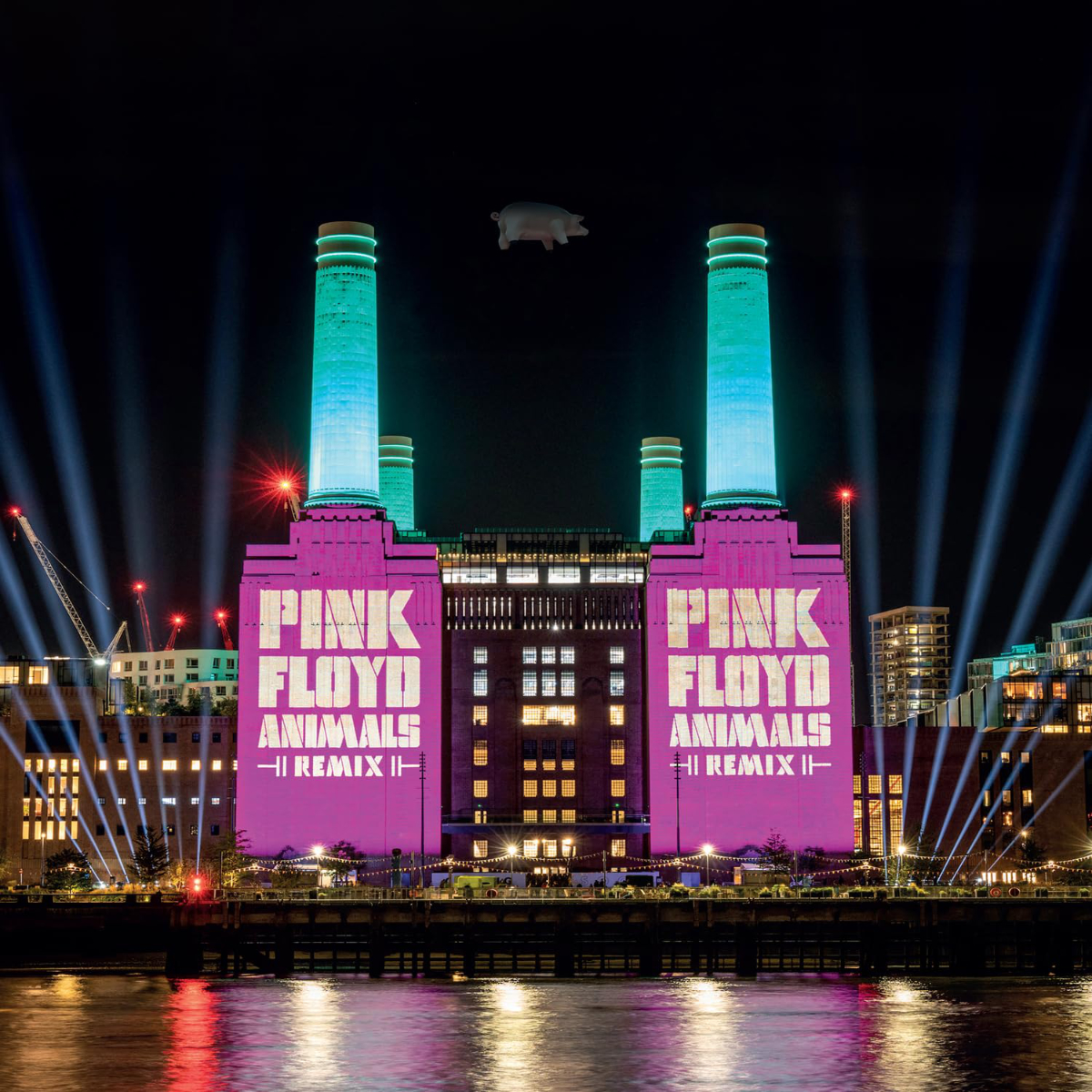
Side of the Moon (the one with the prism), 1977's Animals
(pig-shaped dirigible flying over drab factory town), and 1994's
The
Division Bell (huge, Easter Island-looking heads facing
each other).
"I
was a little intimidated," Bailey admits. "I was thinking,
'He's a 50-something, successful British designer. What might he
be like? He might be a little condescending, perhaps.'" Turned
out to be quite the clown, full of that famous British wit. "I
was paying, like, $1.09 a minute to talk to him in London,"
Bailey adds.
The
entire 35-minute interview will air on the October 29 "Floydian
Slip" broadcast (with a transcript
to be posted at the Web site afterwards).
Still, even all the heady 'Net talk leaves Bailey seeming a bit
remote. "I'd be willing to bet that one in 20, one in 30 [of
his Web site subscribers] is local," he says. "You get
nuts from all over the place who can't get enough of Pink
Floyd information and want a playlist from a radio station in
Burlington. It's really kind of strange."
While Bailey's virtual-world status as a Floyd fan and information
broker is a praiseworthy achievement, his connection to area fans
brings other Floyd phrases to mind: "Hello, hello, hello/Is
there anybody out there?"
Floydian
Faves
Craig
Bailey's top 10 Pink Floyd tunes are listed alphabetically.
He also notes that this list does not include any of the 16 solo
albums in his collection.
This
article originally appeared in Seven
Days on Oct. 22, 1997. Copyright Da Capo Publishing Inc.
Places
to Go
Vermont
Colchester:
The weekly
Pink Floyd program, Floydian Slip, will celebrate its fourth anniversary
this coming October. The show, which airs on Sunday evenings from
7:00 p.m. to 8:00 p.m. on Champ 101.3, was begun ten years ago by
producer and host Craig Bailey at Ithaca College in New York. For
more info on the show, point your browser to its Website at www.floydianslip.com.
This
article originally appeared in Relix Magazine in 1999. Copyright
Relix Magazine.
From
Band to Bandwidth: Popular Local Radio Show Takes to the Net
Craig
Bailey's groundbreaking Floydian Slip radio show/Internet
site exemplifies the possibilities of cross-media promotions
by
Karen Carroll
o
there's this band that you love. And you've got a nagging inkling
to work in broadcasting, but your station has gone belly-up. Should
you give up your hobby or find a creative outlet? If you're Craig
Bailey, you join millions of fans on the Internet.
Floydian
Slip, a weekly radio program on Champ 101.3-FM, is the self-proclaimed
"passion" of local arts guy, Craig
Bailey. A communications graduate of Ithaca College, he is
no stranger to the local airwaves, having spent five years in
the Washington County market and a shorter stint in Burlington
at the now defunct, WEXP-FM.
The program
originated at Ithaca, using a far less creative name, in the mid-80's,
and was resurrected at WEXP in 1994. After the station went dark
in 1995, Floydian Slip went on hiatus until it found a new home
and sponsors at Champ-FM later that year. The show, Wednesdays
from 10:00 to 11:00 p.m. (Addendum: Sundays 7-8 p.m. as of March
22, 1998 ccb), is a one-hour exploration of Pink
Floyd, its members, and its sound.
Floydian
Slip, however, is not just a radio show. It is supplemented by
an extensive Internet website created and maintained by Random
Precision Productions at www.floydianslip.com.
The site
includes a full discography of the Floyd's 20 or so releases, along with solo
efforts by members and compilations. Each recording has a full
review and song list (bits of some songs are available through
RealAudio clips). If your web browser supports forms, you can
even submit a request for a cut directly from the review of the
album it appears on. Handy.
What makes
the Floydian Slip website different from other electronic homages
is its professional presentation. Most pages produced by (any)
band's fans contain at least one "XYZ is GOD!" proclamation.
Not so here. Bailey and company show their allegiance and enthusiasm
with their thoroughness and tenacity. They have tackled the tedious
task of chronicling the group's 30-year history, and the result
is an easy-to-use encyclopedia of Pink Floyd
trivia.
After having
heard the show, you'll know that Bailey, being a true fan, is
not eager to interrupt the musical flow. His breaks are brief
and succinct; it is obvious that if you want to know more about
a track, you can learn about it on the site. In the meantime,
he packs as much music into an hour as he can.
If nothing
else, it seems amazing that Bailey, who supports himself as an
editor and webmaster for a local business publication, has taken
a hobby to such an extreme. His
brief biography is quick to state that maintaining the site
and pushing the show doesn't pay the bills. He is, however, willing
to spend his spare time listening to whatever other Floyd fans
send him, including bootlegs and band demos. And if you send Bailey
$15.95, he'll even send you a t-shirt.
(Addendum: Price now $14.95 cb)
As Internet
promotions continue to grow, Floydian Slip's digital niche will
lose its originality. For now, though, Craig
Bailey should be quite proud of the phenomena he has nurtured
in the Burlington area.
This
article originally appeared in Vermont NOW on April 14, 1997.
Copyright Net Resources Inc.
Is
there anybody out there?
Craig
Bailey, the local playwright/webmaster/ editor/radio host who
won a Bessie for his work with Theatre
Factory, will celebrate an anniversary Oct. 22. That day will
mark the second year he has produced and hosted "Floydian Slip"
on local rock 'n roll station Champ 101.3. The Slip is a weekly radio
program devoted to Pink Floyd, that British
band of the sixties and seventies who brought us the concept albums
The
Wall, Dark
Side of the Moon, as well as Ummagumma
(one of the greatest rock album titles ever). Floyd fans can tune
in (with their headphones securely in place) to the anniversary show
as Bailey plans to oversee a special all-request show. Then, one week
later (that would be Oct. 29 if you can't hear me with the headphones
on) Storm Thorgerson, the designer of 14 Floyd
albums will be Bailey's guest on the Slip. Thorgerson created the
first Pink Floyd album cover in 1968 (Piper
at the Gates of Dawn) and went on to create covers for Dark
Side of the Moon, Wish
You Were Here, Animals
and more. Thorgerson also created covers for Led Zeppelin, Peter Frampton,
Black Sabbath and a host of other seventies bands five of the
Rolling Stones' top 10 album covers of all time were designed by Thorgerson.
He has also directed 10 films that are shown during Floyd concerts
and has been nominated for seven Grammy awards. Bailey recently penned
an article about Thorgerson's 1978 book, The Work of Hipgnosis:
Walk Away Rene, which will appear in the next issue of Brain
Damage, a Floyd fanzine with a worldwide circulation of 8,000.
If you miss the interview, Bailey will post a transcript
of the entire 35-minute phone interview (only portions will be
heard on the program) on the Floydian Slip website www.floydianslip.com.
You can also check out the site for cool band information and more
about the show. See you on the dark side of the moon.
This
article originally appeared in VOX, Shelburne, Vt., on Oct. 15,
1997. Copyright New Market Press Inc.
All
Floyd all the time
For fans of
Another Brick in the Wall, here's the radio show for you! Craig
Bailey offers a reprise of Floydian Slip, a weekly hour's worth
of Pink Floyd Wednesday nights at 9 pm WCPV
(Champ) 101.3 FM. The British rockers have released 20 albums in 30
years including Us and Them: Symphonic Pink Floyd,
currently at the top of the classical charts and are scheduled
to be inducted into the Rock 'n' Roll Hall of Fame on January 17.
"How can you play a bad Pink Floyd song?"
asks WCPV program director Rich Haskell. "There's no such thing."
Maybe so, but perhaps listener I.D.s should be checked, given the
subversive sing-along lyrics of the children's chorus in The
Wall: "We don't need no education. We don't need no
thought control. No dark sarcasm in the classroom. Teachers, leave
those kids alone."
This
article originally appeared in VOX, Shelburne, Vt., on Nov. 5, 1995.
Copyright New Market Press Inc.
Etc.
Think
Floyd
When we grew
up and went to school, there were certain teachers who would call
us "lazy" for sitting around listening to Pink
Floyd's "Dark Side of the Moon"
over and over and over again.
Apparently that's not the case at Gold Coast Music Academy in Renton,
Wash., where the Champ 101.3 radio show "Floydian Slip" is being
used as a study aid for a course called "Pink
Floyd 101." Music Professor Karl Anderson and "Floydian Slip"
host Craig Bailey began corresponding
in August. Anderson told Bailey of his plan to incorporate tapes
of the Floyd-themed show into his curriculum.
The class covers the band's 30-year evolution from stoner icons
("Ummagumma") to concept-rock gods
("The Wall"), as well as the band
members' bitter rivalries and, according to a news release, "collectibles."
"Floydian Slip"
airs from 7 to 8 p.m. Sundays on Champ 101.3 FM. For more information,
log on to www.floydianslip.com
From
The
Burlington Free Press, Oct. 13, 1999. Copyright McClure Newspapers
Random
Notes
Readers in the Burlington, Vermont area
should tune to 101.3 FM each Wednesday night from 10-11 pm (Addendum:
Sundays 7-8 p.m. as of March 22, 1998 ccb) to hear "Floydian
Slip," a program by Craig Bailey devoted entirely to Pink
Floyd ...
From
issue 38 of Brain Damage, The International Pink Floyd Magazine,
March/April 1996. Copyright Brain Damage Magazine Inc.
Winooski
Pink Floyd radio show celebrates four years
on the air
"Floydian Slip",
a weekly Pink Floyd program on Champ 101.3
in Colchester, Vt., celebrates its fourth anniversary on Sunday, Oct.
24.
The program
is produced and hosted by Craig Bailey,
32, of Winooski. (Bailey was born Aug. 3, 1967, the day before Floyd
released it's first album, "The Piper
at the Gates of Dawn.") He began "Floydian Slip" 10 years ago
at 106-VIC,
Ithaca College, Ithaca, N.Y., and brought it to the now-defunct
WEXP-FM, Burlington, in early 1995, before moving it to Champ in
October 1995. The show airs each Sunday from 7 to 8 p.m.
Over the
years "Floydian Slip" has presented music by Pink
Floyd and solo works from all its members every week. Bailey
aired an interview with Floyd designer Storm
Thorgerson, from his London studios, on Oct. 29, 1997. The program
has co-sponsored appearances by Pink Floyd
cover band The Machine in the Burlington area on more than one occasion.
The Web site
Bailey created for his show in spring 1995 routinely receives 20,000
to 30,000 hits a week. In addition to offering information about
the radio program, it includes extensive background on the band;
sound clips; Floyd CDs, T-shirts and other merchandise
for sale online; and much more.
In addition
to producing "Floydian Slip," Bailey is an editor with Business
People Vermont magazine in Williston. He has acted in more than
a dozen plays with Theatre
Factory, the resident theater company of Trinity College of
Vermont, since 1996.
Pink
Floyd is a British rock band founded in the mid-1960s, best
known for its many popular concept albums ("Dark
Side of the Moon," "Wish You Were Here,"
"The Wall") and theatric stadium
shows of the 1970s. Co-founder Roger Waters,
who left the band in the mid-'80s, is touring the East Coast of
North America for the first time in a decade this summer.
Bailey will
celebrate his show's anniversary with Floyd merchandise giveaways
in partnership with pinkfloyddirect.com, the official Floyd merchandise
Web site. The "Floydian Slip" Web site can be found at www.floydianslip.com
From
The Winooski Eagle, Vol. 6, No. 57, September 1999.
Winooski resident
hosts unique radio show
"Floydian
Slip," a weekly Pink Floyd radio show
on Champ 101.3 & 102.1, celebrated its 8th anniversary on Sunday,
Oct. 26th.
Craig
Bailey, 36, began producing "Floydian Slip" in 1989
on 106-VIC, when he was a senior at Ithaca College in Ithaca, N.Y.
He brought the show to Champ 101.3 on Oct. 25, 1995. He has produced
more than 400 installments of "Floydian Slip" for the
Colchester station, where it airs each Sunday night at 7:00.
The show has also aired
on WCVR 102.1 since Champ started simulcasting on that Randolph
station in January 2003.
Floydianslip.com, Bailey's
web site devoted to Pink Floyd, receives several hundred visitors
from all over the world every day. The site was named "Best
Vermont Web Site" in the 2002 Burlington Free Press Readers'
Choice Awards.
Pink Floyd
is a progressive, British rock band founded in the mid-1960s, best
known for its popular concept albums ("Dark
Side of the Moon," "The
Wall") and theatrical stadium shows of the 1970s.
From
The Eagle, Nov. 10, 2003.
Rhythm
& News
by
Pamela Polston
& Ethan Covey
Single
Tracks
"Floydian
Slip," a weekly radio show on Champ 101.3, is celebrating its
seventh anniversary. Host Craig Bailey
began airing his homage to British psych-rockers Pink
Floyd while a senior at Ithaca College in 1989. Still "broadcasting
from the dark side of the moon," Bailey will be quizzing Floyd
fans for a chance to win sets of the group's first seven albums.
Tune in and bliss out Sunday, Oct. 27 from 7-8 p.m.
From
Seven
Days, Oct. 16, 2002. Copyright Da Capo Publishing Inc.
Animal
Sounds
Did you know
the expression "dog days of summer" derives from an annual
mid-season conjunction with Sirius, the "dog star?" This
month, that celestial circumstance is provoking more than wilted
hairdos and perspiration. Craig Bailey,
host of the weekly Pink Floyd tribute show
on Champ 101.3, called "The Floydian Slip," is going all
out with a special program July 22. What's so special about it?
"The Dog Days of Summer" show will spin three recordings
of the band's 17-minute epic entitled what else? "Dogs."
Appropriately, the tune was first released on Floyd's 1977 "Animals"
album. Listeners will hear that version as well as a live one from
PF co-founder Roger Waters and a newer one
from Les Claypool's Frog Brigade. Claypool, as some of you know,
is from Primus, and was in Vermont earlier this year recording a
song with Trey Anastasio of Phish and ex-Police drummer Stewart
Copeland, under the moniker Oysterhead. But that's another story.
Tune in to "Dog Days" and find out how you can win a copy
of "Live Frogs."
From
Seven
Days, July 11, 2001. Copyright Da Capo Publishing Inc.
Wall-Mark
"Floydian
Slip" host Craig Bailey will be
rubbing shoulders figuratively speaking with another
Grammy nominee in an hour-long phone interview with Andy
Jackson from his London studio. The longtime Pink
Floyd engineer is Bailey's guest on his radio show dedicated
to that legendary British prog-rock band, and the interview will
air January 14 and 21 at 7 p.m. on Champ 101.3. Jackson is only
the second such guest on the 5-year-old "Floydian Slip"
Bailey interviewed PF album designer Storm
Thorgerson in 1997.
From
Seven
Days, Jan. 10, 2001. Copyright Da Capo Publishing Inc.
The
dark side of the classroom
Local Pink
Floyd fans have enjoyed Craig Bailey's
weekly broadcast, "Floydian Slip," for several years now
the show he launched as a college student in Ithaca a decade
ago turns four this month on Champ 101.3. But neither Bailey nor
his fans would have suspected the shenanigans of Roger
Waters and David Gilmour would end up
on a syllabus. Enter Karl Anderson, a professor of music at the
Gold Coast Music Academy in Renton, Washington. Turns out he's teaching
a course called what else? "Pink
Floyd 101," and he plans to use some recordings of Bailey's
show in the curriculum. The two "met" following an on-line
auction in August. Actually, Anderson sounds like he deserves his
own show: According to Bailey, the 45-year-old prof has also been
a diving instructor, a writer in natural history, music, animal
husbandry, travel and scuba diving, the head of Wildlife Educators
of America, and has been on both the Discovery Channel/Animal Planet
and TV talk shows. Talk about animal magnetism. Anyway, hooking
up with Burlington's entrepreneurial Floyd fanatic he's also
an actor with Theatre
Factory and the managing editor at Business People Vermont
was fortuitous for Bailey. But, all in all, it's just another brick
in the wall.
From
Seven
Days, Oct. 6, 1999. Copyright Da Capo Publishing Inc.
"Wall"
of sound
Burlington
Pink Floyd fan(atic) Craig
Bailey has expanded his Web site The Floydian Slip to 14,000
words of PF info and trivia surf over to www.floydianslip.com,
which receives 4000-5000 hits a week, he says. Or check out the
sonic equivalent, Bailey's radio show on Champ 101.3 every Wednesday
at 10 p.m. (Addendum: Sundays 7-8 p.m. as of March 22, 1998
ccb)
From
Seven
Days, April 16, 1997. Copyright Da Capo Publishing Inc.
©1995-2008 Random Precision
Media. All rights reserved.
Last
updated: Aug. 13, 2005
|