The Dark Side of the Moon (1973)
Pink Floyd
"There's someone in my head, but it's not me ..."
If Pink Floyd had never recorded an album before "Dark Side of the Moon," and never recorded another after, this 1973 classic would have been more than enough to keep the band in the record books (and in the money) for years to come.
"Dark Side," minus the final song "Eclipse," which was composed later, actually had its public debut during a series of four concerts at the Rainbow Theatre in London in February 1972, a year before the album was released.
While the album was certainly released in March '73, the specific dates seem to be in dispute, with many different dates cited by various sources. The U.K. date of March 16 we're using here has been confirmed by the band's official Twitter account (@pinkfloyd), as well as that of Abbey Road Studios (@abbeyroad). We've taken the U.S. date of March 1 from Wikipedia.
Actually, at the time of its first public performance, the entire piece was called "Eclipse." The name was changed to "Dark Side of the Moon," even though the group Medicine Head had released an album with the same title before Floyd.
The band's first cohesive "concept album," "Dark Side" deals with the notion of how everyday pressures of modern life can lead to madness.
Interspersed throughout, are seemingly random bits of dialogue, sometimes mixed practically below the threshold of consciousness. The snippets come from a series of unrehearsed interviews the band conducted with people who happened to be at EMI's Abbey Road studio at the time. Musicians, roadies, even the doorman of the facility, were set down in front of a mic and shown flash cards with questions like, "When was the last time you were violent?" and "When was the last time you thumped someone?" Segments of their responses were sprinkled throughout the album.
The maniacal laughter came from Roger the Hat, a road manager of another band, while it was doorman Jerry Driscoll who provided the parting shot on the album, saying, "There is no dark side of the moon, really. Matter of fact, it's all dark," as the heartbeat at the end of side two slowly fades to black. Beatle Paul McCartney was interviewed, though his thoughts weren't included on the album.
"Dark Side" was produced by the band between June 1, 1972, and January 1973, and engineered by Alan Parsons. Parsons, like one-time Floyd producer Norman Smith, had done work with the Beatles, and would go on to found The Alan Parsons Project, a studio ensemble that had a handful of hits, and, like Floyd, employed design team Hipgnosis for many of its album covers. Parsons also would produce material for Al Stewart, Ambrosia, Paul McCartney and the Hollies.
Parsons, who earned a weekly salary of 35 pounds per week for his role, was largely responsible for many of the sound effects, most notably the clock montage leading into "Time," on side one. He had recorded the montage to demonstrate the power of quadraphonic sound. (Floyd created a quad version of "Dark Side," as well as 1970's "Atom Heart Mother" and 1975's "Wish You Were Here.")
The album was the group's first number one in the United States. "Money," backed with "Any Colour You Like," made it to number 13 on the Billboard singles chart in the U.S. "Us and Them," originally written as "The Violent Sequence" for the "Zabriskie Point" soundtrack but rejected by the director, was released as a 45, backed with "Time," which climbed to number 101. But it would eventually be the album's longevity more than anything else that would make it so distinctive, for Pink Floyd and the music industry as a whole.
"Dark Side" ended up staying on the U.S. Billboard album chart for a record 15 years, a total of 724 weeks, before it dropped off July 23, 1988. While the album had periodically dropped off the chart before, only to return another week, a change in the way Billboard constructed its charts assured that this time, the album couldn't return. (In fact, "Dark Side" did have a phenomenally long consecutive run: 591 weeks from Dec. 18, 1976, to April 23, 1988.)
It remains the forth best selling album of all time, behind Michael Jackson's "Thriller," the soundtrack to "Saturday Night Fever," and Fleetwood Mac's "Rumours." Ironically, the album was only awarded a gold record, meant to designate a half-million units sold, because it was released before Jan. 1, 1976, when the recording industry established the designation of "platinum," representing a million units sold.
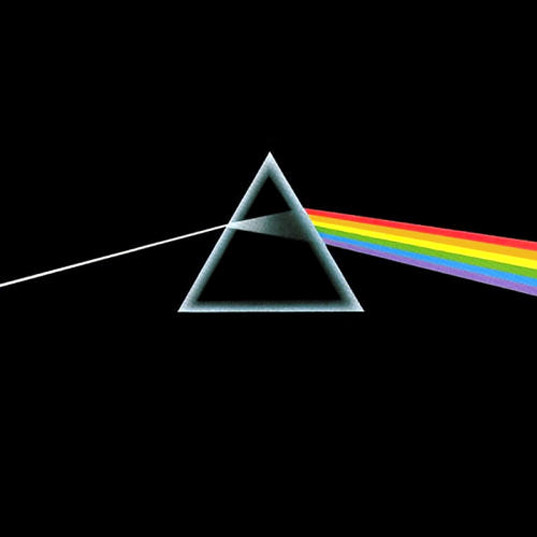
The cover, one of many for the band by Hipgnosis, is a reference to the group's reputation for amazing light shows. It was one of several the design team worked up for the group. When presented to the band, it was chosen above the others in a matter of seconds.
When the LP gatefold is opened up — yes, LPs do have certain advantages to compact discs! — the spectrum continues on the inside of the cover, and around again to the back, eventually connecting again with the front. In this way, the design is indicative of the heartbeat that begins and ends the album, creating a cyclic pattern the Floyd would repeat on other albums, most notable "The Wall" in 1979.
Furthermore, the pattern repeats when several LPs are opened up and placed end to end. Hipgnosis had previously used this concept of the mandala in its design of East of Eden's "New Leaf" (1971) and "Five Bridges" by The Nice in 1970. It would continue the theme in "Tales of Mystery and Imagination: Edgar Allan Poe" (1976), The Alan Parsons Project's first album.
Incidentally, take a close look at the light defracting from the prism, and you'll notice that one color, purple, is missing. Hipgnosis's Storm Thorgerson has said the team purposefully omitted the hue because it believed it wouldn't read properly.
The psychological effect "Dark Side" had on the band was significant. The album was a commercial and critical success, and, unsurprisingly, a tough act to follow.
"Dark Side," minus the final song "Eclipse," which was composed later, actually had its public debut during a series of four concerts at the Rainbow Theatre in London in February 1972, a year before the album was released.
While the album was certainly released in March '73, the specific dates seem to be in dispute, with many different dates cited by various sources. The U.K. date of March 16 we're using here has been confirmed by the band's official Twitter account (@pinkfloyd), as well as that of Abbey Road Studios (@abbeyroad). We've taken the U.S. date of March 1 from Wikipedia.
Actually, at the time of its first public performance, the entire piece was called "Eclipse." The name was changed to "Dark Side of the Moon," even though the group Medicine Head had released an album with the same title before Floyd.
The band's first cohesive "concept album," "Dark Side" deals with the notion of how everyday pressures of modern life can lead to madness.
Voices
Interspersed throughout, are seemingly random bits of dialogue, sometimes mixed practically below the threshold of consciousness. The snippets come from a series of unrehearsed interviews the band conducted with people who happened to be at EMI's Abbey Road studio at the time. Musicians, roadies, even the doorman of the facility, were set down in front of a mic and shown flash cards with questions like, "When was the last time you were violent?" and "When was the last time you thumped someone?" Segments of their responses were sprinkled throughout the album.
The maniacal laughter came from Roger the Hat, a road manager of another band, while it was doorman Jerry Driscoll who provided the parting shot on the album, saying, "There is no dark side of the moon, really. Matter of fact, it's all dark," as the heartbeat at the end of side two slowly fades to black. Beatle Paul McCartney was interviewed, though his thoughts weren't included on the album.
"Dark Side" was produced by the band between June 1, 1972, and January 1973, and engineered by Alan Parsons. Parsons, like one-time Floyd producer Norman Smith, had done work with the Beatles, and would go on to found The Alan Parsons Project, a studio ensemble that had a handful of hits, and, like Floyd, employed design team Hipgnosis for many of its album covers. Parsons also would produce material for Al Stewart, Ambrosia, Paul McCartney and the Hollies.
Parsons, who earned a weekly salary of 35 pounds per week for his role, was largely responsible for many of the sound effects, most notably the clock montage leading into "Time," on side one. He had recorded the montage to demonstrate the power of quadraphonic sound. (Floyd created a quad version of "Dark Side," as well as 1970's "Atom Heart Mother" and 1975's "Wish You Were Here.")
Chart success
The album was the group's first number one in the United States. "Money," backed with "Any Colour You Like," made it to number 13 on the Billboard singles chart in the U.S. "Us and Them," originally written as "The Violent Sequence" for the "Zabriskie Point" soundtrack but rejected by the director, was released as a 45, backed with "Time," which climbed to number 101. But it would eventually be the album's longevity more than anything else that would make it so distinctive, for Pink Floyd and the music industry as a whole.
"Dark Side" ended up staying on the U.S. Billboard album chart for a record 15 years, a total of 724 weeks, before it dropped off July 23, 1988. While the album had periodically dropped off the chart before, only to return another week, a change in the way Billboard constructed its charts assured that this time, the album couldn't return. (In fact, "Dark Side" did have a phenomenally long consecutive run: 591 weeks from Dec. 18, 1976, to April 23, 1988.)
It remains the forth best selling album of all time, behind Michael Jackson's "Thriller," the soundtrack to "Saturday Night Fever," and Fleetwood Mac's "Rumours." Ironically, the album was only awarded a gold record, meant to designate a half-million units sold, because it was released before Jan. 1, 1976, when the recording industry established the designation of "platinum," representing a million units sold.
Iconic artwork
The cover, one of many for the band by Hipgnosis, is a reference to the group's reputation for amazing light shows. It was one of several the design team worked up for the group. When presented to the band, it was chosen above the others in a matter of seconds.
When the LP gatefold is opened up — yes, LPs do have certain advantages to compact discs! — the spectrum continues on the inside of the cover, and around again to the back, eventually connecting again with the front. In this way, the design is indicative of the heartbeat that begins and ends the album, creating a cyclic pattern the Floyd would repeat on other albums, most notable "The Wall" in 1979.
Furthermore, the pattern repeats when several LPs are opened up and placed end to end. Hipgnosis had previously used this concept of the mandala in its design of East of Eden's "New Leaf" (1971) and "Five Bridges" by The Nice in 1970. It would continue the theme in "Tales of Mystery and Imagination: Edgar Allan Poe" (1976), The Alan Parsons Project's first album.
Incidentally, take a close look at the light defracting from the prism, and you'll notice that one color, purple, is missing. Hipgnosis's Storm Thorgerson has said the team purposefully omitted the hue because it believed it wouldn't read properly.
The psychological effect "Dark Side" had on the band was significant. The album was a commercial and critical success, and, unsurprisingly, a tough act to follow.
Release date
Mar 16, 1973 (UK)
Mar 1, 1973 (US)
Rating ( votes)


Thanks for rating "The Dark Side of the Moon"
Track listing
- Speak to Me
01:08 (Mason) - Breathe
02:49 (Waters/Wright/Gilmour) - On the Run
03:51 (Waters/Gilmour) - Time
06:50 (Mason/Waters/Wright/Gilmour) - The Great Gig in the Sky
04:44 (Wright) - Money
06:23 (Waters) - Us and Them
07:50 (Waters/Wright) - Any Colour You Like
03:26 (Mason/Wright/Gilmour) - Brain Damage
03:47 (Waters) - Eclipse
02:12 (Waters)



