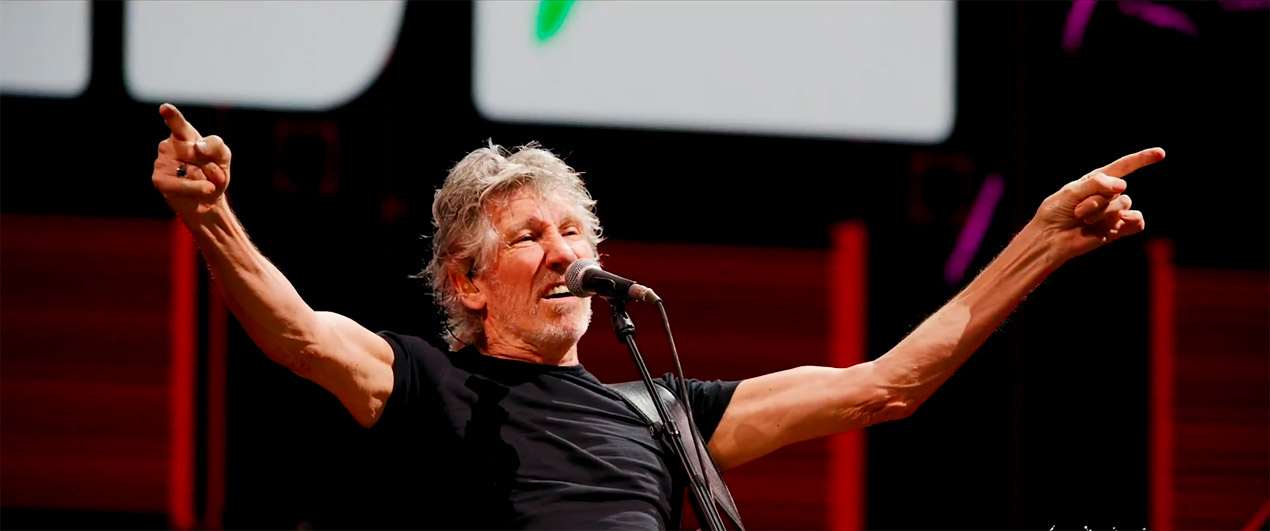
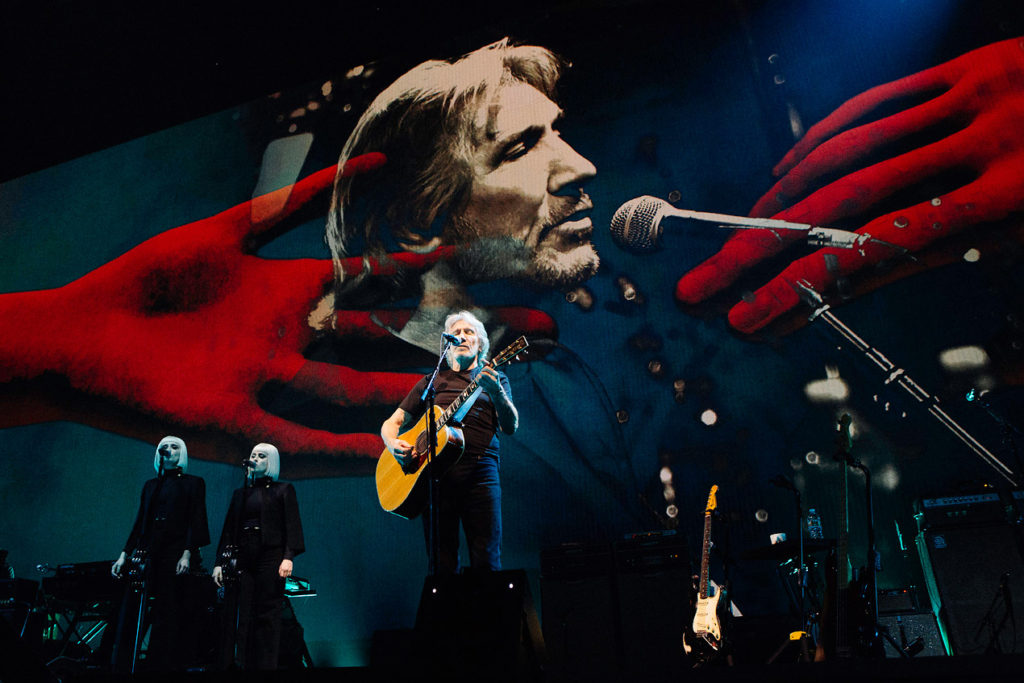
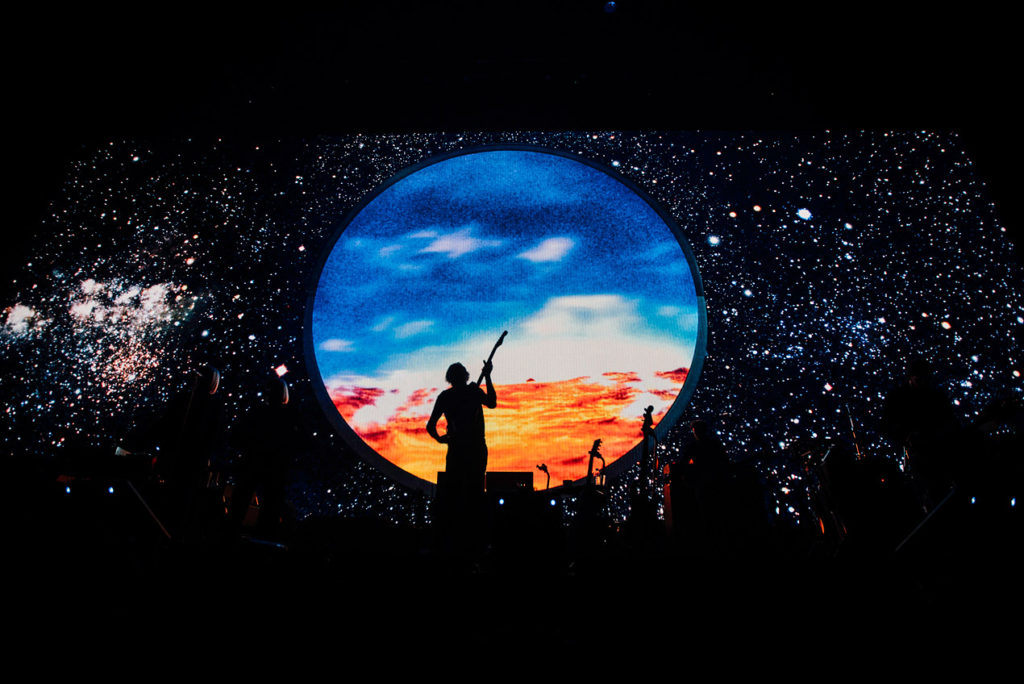
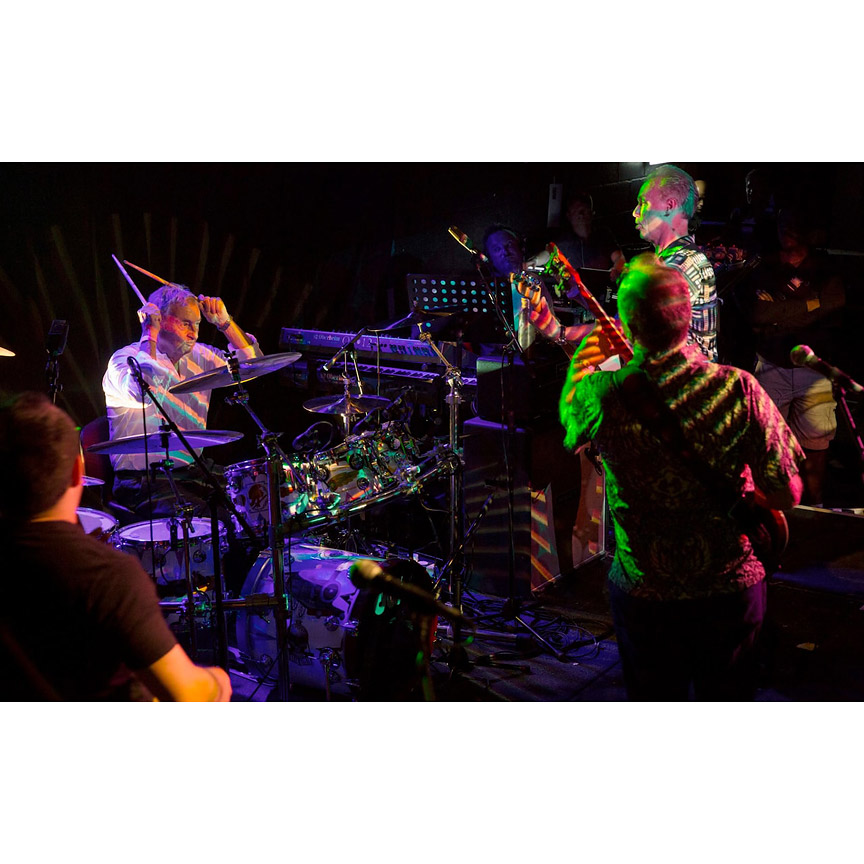
Intrepid Floydian Slip correspondent Ed Lopez-Reyes attended a private advance screening of the film “Roger Waters Us + Them” yesterday, three weeks ahead of its Oct. 2 release. His report follows:
Roger Waters Us + Them Review Thursday, September 12, 2019 Special to Floydian Slip by Ed Lopez-Reyes
The intersection of beautifully crafted sound and footage combined with director Sean Evans‘ ability to turn an action-packed, live performance into an atmospheric, ethereal experience raises the bar for concert video.
Recorded during a series of June 2018, Amsterdam performances, “Roger Waters: Us + Them” is so exquisitely constructed it emancipates the film from traditional and repetitive templates employed in comparable efforts: the music takes center stage as the expression of ideas Waters and the audience wish to converse about unfold in an exchange between the twain: it takes a talent of Evans’ caliber to capture that. This film documents that dynamic with great cinematic power.
Within the film’s first couple of minutes, the crisp and brutally visceral sound of clapping thunder blends seamlessly into the sound of artillery, garnishing footage of a child sitting on a shore (part of the storylines that run on the background screens during the live performance). This brief introduction segues into the visual of Roger Waters taking the stage. In that brief convergence of audiovisual elements Evans manages to bewitch the audience, realigning their senses for an unusually gripping concert documentary.
The audience plays a central role in this film. It is never veiled in a sea of black. Instead, its interaction with the artist is central to the story and its voice is accentuated by the colors that flood the arena as this emotive call and response transpires.
Evans has gifted the viewer with a full set of perspectives: from the panoramic shots originating in the most remote points of the arena to the great and abundant shots taken from behind drummer Joey Waronker‘s viewpoint on stage. Even with all these perspectives, the approach never breaches the viewer’s commitment to the plot: the intentions of the live production (the track order, the visual effects, the lighting choices, and the background screen storylines) are all served well by Evans’ cinematic choices — and the viewer remains engaged while imbibing the performance from a diverse set of vantage points.
The audience and Waters are the crucial co-stars in this film — but if there is anything you should take away from this production it should be a realization that Evans has earned his stripes and a key place in the creative tradition of Storm Thorgerson: not because his work resembles Thorgerson’s but because it shares an important trait, namely, ambition that is successfully met by equal and greater ability. Evans has created a style of his own that flows naturally from within the historical context and style that spawns the intersection of his creative life with Waters’.
There is something striking about Evans’ sense of photographic cadence. The close-up shots of the musicians working their craft, the panoramic shots of an audience bathed in a cornucopia of lights and the powerful attention to sound details make “Roger Waters: Us + Them” a mesmerizing experience. Although these may all sound like common elements in any concert film, they are particularly striking in this work and converge robustly into an experience from beginning to end. It is a sustained audio-visual journey all the way through.
The first third of the film delivers some of Pink Floyd’s most prominent material, launching with tracks like “Time” and “The Great Gig in the Sky.” The set makes a steep ascent with “Welcome to the Machine,” its aggressive swagger elevating the band’s performance into perfect cohesion while creating space for each musician to shine on their own: Waronker’s drumming is particularly impressive, reminding listeners of Nick Mason‘s crucial role in shaping Pink Floyd’s sound; judgments that Mason’s drumming is too simple have always been over-simplistic themselves — the way Waronker (and Graham Broad before him in Waters’ band) plays and weaves all these tracks together is a great reminder of the texture Mason added to Pink Floyd’s music.
As the live performance (and the film) shift toward Waters’ most recent studio material during the second third of the film, it is the integrity, cohesiveness, and great musicianship of this band that helps sustain interest past the Pink Floyd classics: not for lack of enthusiasm for the new material (it is quite incredible watching audience members sing along, word for word, to the new tracks) but because it requires sustaining momentum after these “classic” tracks have been played back-to-back. The band succeeds in cultivating an appetite for this material and in bridging from it to another set of classics toward the conclusion of the show.
“Wish You Were Here” and “Another Brick in the Wall” (parts two and three) set the stage for some of the material that fans had been imploring Waters to play live in the years preceding the Us + Them tour. The last third of the show consists of epic Pink Floyd classics, the most intense use of stage production and effects, and the strongest political statements in the film.
Evans may have faced one of his biggest challenges here: capturing the magic of the production that unfolds during this part of the set may be an insurmountable task for many — but Evans delivers. Even if you are someone who has experienced the performance more than once in person, you owe it to yourself to take it in through Evans’ directorial eyes: the mix of angles and the bird’s eye perspective, used interchangeably during the film, really fleshes something additional.
Of course, this part of the performance and the film presents what some might perceive as an additional layer of challenges: this is the part of the concert that gets into the heaviest political discourse.
Evans, who shares many of Waters’ politics, is disciplined about balancing his personal passion for the message with its presentation to the broader public and in balance with the attention the music and stage production deserve. It is a careful balance to strike over the course of a handful of tracks and through its performance of “Money” (which, it must be noted, boasts some of the wildest surround sound details in the entire film).
What is most striking about the political content is how much of it is fueled by populism – on both sides of the spectrum.
So where do the rest find refuge? Despite the ironies, “Us and Them” seems to be the poetic force that ultimately helps bind us all together: “Me and you, God only knows it’s not what we would choose to do.” It’s the moment the anger simmers and you get the sense that there is hope and that, perhaps, somewhere deep inside we might all care for the same fundamental goals: “Black and blue… And who knows which is which, and who is who.”
The film closes with “Brain Damage” and “Eclipse” — both performances will give you goosebumps. Though you might ask yourself what happens to “Comfortably Numb,” Waters and Evans’ choice to close with “Eclipse” is the right one, especially when you take into account Waters’ last words as the film closes. Despite all the anger that drives the politics in our world today, ultimately we all want to reach the same goals — even if some have to search more profoundly for these basic human desires.
Those who have followed Waters’ work owe it to themselves to see this in a large movie theater before it becomes exclusive domain of DVD and streaming media. The work Evans and Waters have done on the sound is mind-blowing and the way they elevate the audience’s presence in the performance is superb. The shots are so vast you feel like an audience member taking the performance in from various points — even from the stage.
There is an interesting dynamic between the pace of the show (fast) and the pace of the film (a slow burn): somehow, Evans manages to serve us a moving picture of great detail — even as the live performance moves at an intense pace. This is an artistic accomplishment in its own right: you will find yourself assimilating the pace at which a camera moves from one side of the stage to the other realizing how much detail, on so many things, you have just taken in. There is a certain magic in that — and that is hard to capture live. It certainly does not diminish the live experience but is a statement about what you get from a cinematic experience when there is a good director at the helm. This is magnified on a large screen and the opportunity to experience it this way is limited.
Floydian Slip is partnering with Trafalgar Releasing to give you tickets to “Roger Waters Us + Them,” the new concert film coming in October.
A document of Waters’s 2017/18 tour of “Is This the Life We Really Want?,” “Us + Them” plays theaters two nights only: Wednesday, Oct. 2 and Sunday, Oct. 6.
Register now to win a pair of tickets good at the participating theater of your choice.
Yesterday’s much-anticipated auction of David Gilmour‘s guitars raised $21,490,750 for charity.
The highlight of the Christie’s auction held in New York City was the Pink Floyd frontman’s fabled “Black Strat,” which sold for $3,975,000, way beyond the official estimate of $100,000 to $150,000.
Gilmour bought that Fender Stratocaster in New York City in May 1970, and played it extensively through the ’70s and into the ’80s on such recording as “The Dark Side of the Moon” (1973), “Wish You Were Here” (1975), “Animals” (1977) and “The Wall” (1979).
The winning bid for the Black Strat came from Jim Irsay, owner of the Indianapolis Colts. Larry Hall, vice president of special projects for the NFL team, attended the auction as Irsay’s proxy.
Other highlights include Gilmour’s ’54 Stratocaster, serial number 0001, used for the rhythm track on “Another Brick in the Wall Part 2,” which went for $1,815,000; a ’69 Martin D-35 used on “Welcome to the Machine” and “Wish You Were Here,” (also sold to Irsay) for $1,095,000; and his 12-string Martin D12-28, used to write and record the opening riff for “Wish You Were Here,” sold for $531,000.
According to Christie’s, the Black Strat breaks the record for a guitar sold at auction, and is the most ever paid for a Stratocaster. Previously, the most expensive guitar sold at auction was the “Reach Out to Asia” Stratocaster, auctioned to support victims of the 2004 tsunami.
That item sold in 2005 for $2.7 million. It had been signed by Gilmour, Mick Jagger, Keith Richards, Eric Clapton, Jimmy Page, Pete Townshend, Jeff Beck, and others.
Irsay has a few other notable guitars in his collection, including an orange ’63 Gretsch once owned by John Lennon and purchased for $530,000 in 2015; and the “Yellow Cloud” guitar played by Prince, which Irsay purchased for $137,500 in 2016.
The day before the auction, Gilmour announced all proceeds would benefit ClientEarth, an organization that funds attorneys and other experts to fight climate change.
“The global climate crisis is the greatest challenge that humanity will ever face, and we are within a few years of the effects of global warming being irreversible,” Gilmour said.
“I hope that the sale of these guitars will help ClientEarth in their action to use the law to bring about real change. We need a civilized world that goes on for all our grandchildren and beyond in which these guitars can be played and songs can be sung.”
The auction lasted eight hours with bidders from 66 countries participating.
Pink Floyd guitarist David Gilmour will publish “Three Different Ones,” a three-part podcast series beginning tomorrow.
The podcast is a prelude to the upcoming auction of 120 of Gilmour’s guitars taking place in New York on June 20.
Episode 1, dropping May 31, focuses on his legendary black Stratocaster. The June 7 episode covers the 6- and 12-string Martin acoustic guitars he used in writing and recording “Wish You Were Here” (1975). And the series concludes June 14 with a final episode about his white Strat, serial #0001.
Auctioneers Christie’s announced the Gilmour auction in January. All proceeds will go to charity.
The entire collection was on display at Christie’s on King Street, London, March 27-31. Selected guitars were displayed in Los Angeles May 7-11. Your final chance to see them will be in New York as part of the sale preview that runs June 14-19.
Pink Floyd Records will reissue the band’s 1968 album “A Saucerful of Secrets” in its original mono mix for Record Store Day April 13.
James Guthrie, Joel Plante and Bernie Grundman worked from the original 1968 mono mix for this reissue. Pressed onto 180-gram vinyl, it’ll come with a faithful reproduction of the LP’s original artwork, including the Columbia logo. (Early Floyd albums were released in the U.K. sporting the Columbia logo, via EMI.)
The “Saucerful” reissue will be limited to 6,500 albums.
Last year, the band offered a reissue of “The Piper at the Gates of Dawn” (1969) for Record Store Day.
Record Store Day was conceived in 2007 as a way to celebrate and support independently-owned record stores.
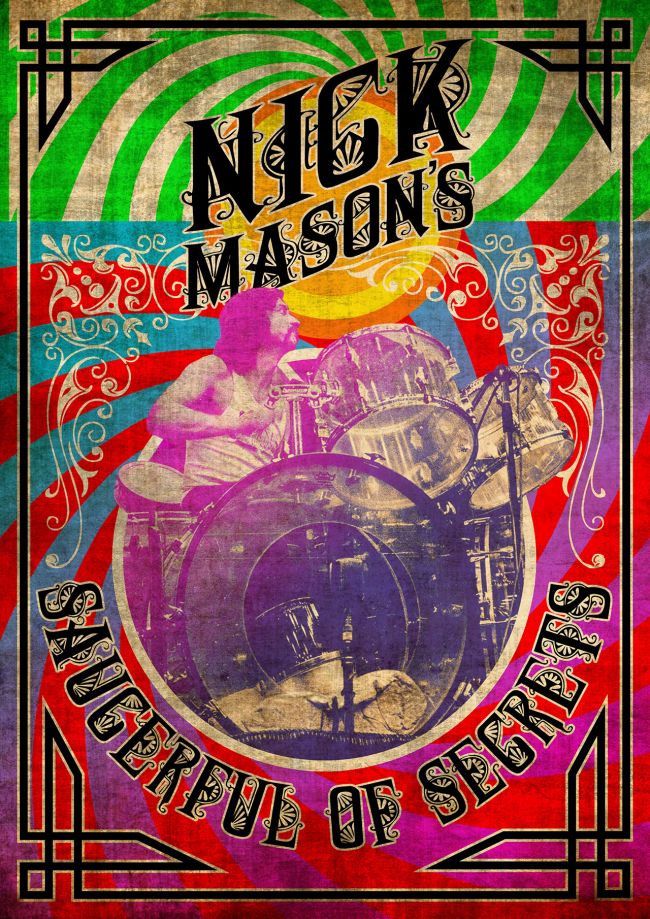
Pink Floyd co-founder and drummer Nick Mason will bring his group Saucerful of Secrets to North America in 2019.
The group announced its first concerts outside of Europe: 25 dates in Canada and the United States beginning March 12 in Vancouver and ending April 22 in Washington, D.C.
The group debuted in London this May, before launching a tour of Scandinavia and Europe that ran during September.
The band consists of Mason, Spandau Ballet‘s Gary Kemp, former Floyd bassist Guy Pratt, Blockheads guitarist Lee Harris, and producer/composer Dom Beken. They play the early music of Pink Floyd.
The 2019 dates also include five more U.K. dates:
North America
Mar 12, 2019 – Queen Elizabeth Theatre, Vancouver
Mar 13, 2019 – The Paramount, Seattle
Mar 15 2019 – The Masonic, San Francisco
Mar 16, 2019 – The Wiltern, Los Angeles
Mar 19, 2019 – Comerica Theatre, Phoenix
Mar 21, 2019 – Paramount Theatre, Denver
Mar 24, 2019 – Pavilion At Toyota Music Factory, Dallas
Mar 25, 2019 – Jones Hall, Houston
Mar 27, 2019 – The Fillmore At The Jackie Gleeson, Miami Beach
Mar 29, 2019 – Tabernacle, Atlanta
Mar 31, 2019 – Stifel Theatre, St Louis
Apr 1, 2019 – Riverside Theater, Milwaukee
Apr 3, 2019 – Orpheum Theatre, Minneapolis
Apr 4, 2019 – Chicago Theatre, Chicago
Apr 5, 2019 – The Old National Theatre, Indianapolis
Apr 7, 2019 – Palace Theatre, Columbus
Apr 8, 2019 – Civic Center, Akron
Apr 9, 2019 – The Fillmore, Detroit
Apr 11, 2019 – Shea’s Performing Arts Center, Buffalo
Apr 12, 2019 – Oakdale Theatre, Wallingford
Apr 13, 2019 – Orpheum Theatre, Boston
Apr 15, 2019 – Place des Arts, Montreal
Apr 16, 2019 – Sony Centre For The Performing Arts, Toronto
Several pieces of original Pink Floyd album artwork by Hipgnosis and Gerald Scarfe are part of an exhibit in downtown San Francisco.
“Art of the Album Cover” opened Saturday at the San Francisco Art Exchange (SFAE). It’ll run through October.
The exhibit includes nearly 100 original works, including layered concept drawings for Floyd’s “The Dark Side of the Moon” (1973), “considered to be the single most valuable artwork in rock history,” according to SFAE.
The drawings constitute a three-layer mock-up done on transparent paper that served as a guide for the printer in manufacturing the cover.
According to the exhibit’s catalog, “These drawings were utilized in much the same way that builders construct a house. The final ‘work of art’ is the house itself, but the creative original artworks were the plans for the house (think Frank Lloyd Wright). These three drawings bring the final artwork to life as each is superimposed over the other — guiding the printer to the final achievement.”
Frank Floyd Wright, more likely.
The price of the “Dark Side” piece is listed only as “Price on request” in the SFAE catalog. “The most expensive prices aren’t shown for a variety of reasons,” SFAE founder and executive director Jim Hartley explained to Floydian Slip. “Several of the more spectacular pieces go into the seven figures, as you might imagine.”
Other Floyd-related pieces include the original montage to 1969’s “Ummagumma” and a C-print photo of that album’s back cover; the original dye-transfer airbrushed photo that appeared on the cover of the U.K. edition of “Wish You Were Here” (1975); a number of Scarfe sketches of the band from its ’74 U.K. winter tour program; and a 2017 commemorative print of “The Wall.”
All original Floyd pieces are signed.
Other albums featured at the exhibit include “Abbey Road,” “Rubber Soul,” “Meet the Beatles,” “Beggars Banquet,” “Candy-O,” “Hair,” “The Best of the Doors,” “Blonde on Blonde,” “At Folsom Prison” (Johnny Cash), and many more.
All pieces come from private, corporate, and artists’ collections from around the world.
Pink Floyd drummer and founding member Nick Mason will take his group Saucerful of Secrets on a 21-date tour of Scandinavia and Europe this fall.
The announcement comes on the heals of the group’s four sold out shows in London (pictured) this past week.
The group, which includes Spandau Ballet‘s Gary Kemp, former Floyd bassist Guy Pratt, Blockheads guitarist Lee Harris, and producer/composer Dom Beken, plays early Floyd tracks from the group’s Syd Barrett and soundtrack eras.
The tour starts Sept. 2 in Stockholm, and wraps Sept. 29 in Nottingham. It’ll be Mason’s first tour since Floyd’s ’94 concerts supporting “The Division Bell.”